• Home
  • About the book
  • About the author

MADE IN AMERICA

Notes on American life from American history.

Feeds:
Posts
Comments
« Alone or Lonely?
Who Has Your Back »

A Natural Romance

August 18, 2010 by Claude Fischer

I recently noticed a newspaper ad for Amtrak: Designed in American Craftsmen style to evoke, say, 1910, a poster displays the silhouette of a woman, hair in a bun, sipping a hot beverage. Through a train window behind her we can see a landscape of high mountains and tall evergreens.  The title of the ad reads, in caps, “more human / more nature.”  (A video version is here.)
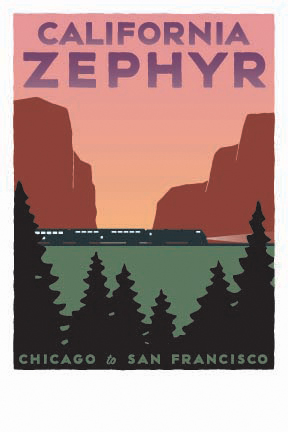
Trains, the ad tells us, are our vehicles for returning to a slower time, a more natural time, a more human time.

Irony alert! The train was, to humanists and other sensitive souls of the 19th century, the central symbol of modernity – the main destroyer of life at a natural, harmonious, human scale. The unintentional joke in the ad plays off the running tension between new technologies, old technologies, and our notions of the “natural.” Knowingly or not, the ad’s creators point out how the modern world defined the “natural” one.

New Devices, Old Crafts

In a famous passage in his famous 1854 book extolling the wonders of nature, Walden: Or, Life in the Woods, Henry David Thoreau describes how the whistle of a nearby locomotive breaks his communing with nature; he compares its sound to the screech of a hawk. Thoreau then describes the city merchants riding the train out to the countryside as  predatory hawks. This passage is a critique of commercial, urban civilization advancing on iron wheels to ruin nature and “natural” ways of  life – a common view among the romantics of his era. (Leo Marx wrote a classic study on the era and the mindset: The Machine in the Garden.) Today, Amtrak and many train enthusiasts describe trains as the human, natural means of transport.

This elevation of older technologies into the romantic category of more human, natural technologies is common. When computers came in, essayists enjoyed writing eulogies to the typewriter; I’m sure that when typewriters came in, people bemoaned the loss of the more “natural” pencil; and I would suspect that lovers of parchment scrolls regretted the printing press. Critics of television waxed nostalgic about radio programs while critics of the radio in the 1920s worried about what it was doing to live performances. When email proliferated, sage observers bemoaned the loss of that human quality, the sound of voices, which  the telephone provided; but when the telephone became popular, commentators complained about how a mechanical device was displacing more natural conversation and more human letter-writing. (Letter-writing, by the way, required considerable technological infrastructure – in the 1700s, “paper, quills, ink, sealing
wax or wafers, inkpots, and penknives [for trimming quills]” [see here], not to mention stagecoaches and other means of delivery.) As a final example, more than one commentator on household technologies has suggested that washing machines displaced the  “natural” way of cleaning — lugging water from wells, chopping wood, stoking furnaces, and hand-scrubbing.

Seeing older technologies as more natural appears in the way we talk of older technologies as “crafts.” Some people today enjoy the kind of hand-making of clothes that their great-grandmothers gave up for sewing machines and their grandmothers gave up for mass-produced clothing; it was a chore, it is now a craft. The glassware and sealing technology 19th century women used to save food for the winter has become the natural craft of preserving. In a similar vein, I sense that a nostalgia that 1970s and ’80s computer code-writing is a lost, endangered craft.

Nature Nostalgia

Beneath the nostalgia about old technologies is the deeper western, particularly American I suspect, nostalgia about nature. A sentimental view of nature – institutionalized in our national park system, wilderness areas, and major urban parks – is a world-view that, as someone pointed out to me decades ago, only an advanced, technological civilization would develop.

Thoreau cabin replica (dancingbarefoot3)

In most of human history, people viewed raw nature as fearsome, to be avoided, passed through quickly, a brutal test, and to be beaten back. (Consider nature and its bestiary in the Bible; even today villagers in places like India fear wild animal attacks.) Enlightenment thinkers and 19th century romantics could, most of them from a safe  distance, imbue untouched nature with  purity, which provided a standard of innocence that rebuked the corruptions of the emerging urban society. Thoreau could in this spirit disdain the materialism of his fellow New Englanders from his perch in the woods (– well, actually, from a cottage he used on Ralph Waldo Emerson’s farm, near Mrs. Emerson’s kitchen, and a short walk from town).

We have inherited this American world view. I, too, have been thrilled when backpacking into the “pristine” wilderness; I, too, tried to teach my children to feel the awe and inhale the moral uplift of nature – even as I understood that these reactions were as “natural” as feeling moved by, say, William Shakespeare, Rembrandt van Rijn, or Willie Mays – not natural at all, but learned.

Were Henry David Thoreau around today, I would enjoy a train ride with him through, say, the Rockies; we would feel refreshed by human encounter with nature, thanks to Amtrak.

Share

About these ads

Share this:

  • Share
  • Email
  • Facebook
  • Twitter
  • Reddit
  • StumbleUpon
  • Tumblr
  • LinkedIn
  • Google +1
  • Digg

Posted in Uncategorized | Tagged natural, nature, technology, trains |

  • Made in America: Now available in Paperback, on Kindle, and via Google eBook

  • Enter your email address to subscribe to this blog and receive notifications of new posts by email.

    Join 135 other followers

  • Comment Back to:

    madeinamericathebook @ gmail.com
  • * 2010 winner, PROSE Award for U.S. History, American Association of Publishers.
    * "A shrewd, generous, convincing interpretation of American life" -- Publishers Weekly
    * "Masterful and rewarding . . . exactly the sort of grand and controversial narrative, exactly the bold test of old assumptions, that is needed to keep the study of American history alive and honest" -- Molly Worthen, New Republic Online
    * "... brave and ambitious new book ...." "Made in America sheds abundant light on the American past and helps us to understand how we arrived at our own historical moment, and who we are today." -- David M. Kennedy, Boston Review

  • Pages

    • About the book
      • Corrections & Updates
    • About the author
  • Previous Posts

    • Race in the Eye of the Beholder
    • Getting Smarter
    • Suicide Boom?
    • Tweedledee-Tweedledum Nostalgia
    • Sexual License, Sexual Limits
    • Markets, Prices, and Justice
    • Immigration and Political Clout
    • Is the Gender Revolution Over?
    • Writerly Baseball – Opening Day 2013
    • Back Home
    • Catholic Schism
    • How Material Are We?
    • Unholy Alliance: Laissez Faire and the Church
    • The ’60s Turn 50
    • The Left’s Religion Problem
    • Paying Attention to the Kids
    • We’re # Last!
    • Risk Taking
    • The Elderly and Their Children
    • Guns
    • A Modern “Antebellum Puzzle”?
    • Makes One Anxious
    • Psychological Labeling … and Enabling?
    • The Giving Nation?
    • Religion, Politics, and the Sunday Mail
    • The Happiness Boom
    • What Americans Have Been Thinking
    • The Verdict on Class and Voting
    • Panderocracy
    • 9/11 Reaction and Resilience
    • A Cost of Inequality: Growth
    • Obama’s Racial Penalty
    • Choose Your Choice
    • To the Poorhouse
    • The Polarizing Political Paradox Redux
    • The 47% Charge in U.S. History
    • The Survey Crisis
    • Competitive Intelligence
    • Execution Songs
    • Spiritual and/or Religious
    • “Who Built That?”: Chance and History
    • Meeting, Mating, and the Web
    • Live Long and Prosper — and Plan
    • Voting Violence
    • Sex and the American Car
    • The Assets Gap
    • Differences Under the Differences
    • Why Americans Don’t Vacation
    • Virtuous Voting
    • Clothes Make the Common Man
    • Driving Blind
    • Geography of Inequality
    • Slavery’s Heavy Hand
    • Gay Vows
    • Explaining Poverty (Again)
    • Out- and Insourcing
    • Still Under God
    • The Loneliness Scare is Back
    • Sunday Pleasures, Private Faith
    • Between Dole and Market
    • Opening Day 2012 – Worldwide
    • Tolerating Americans
    • What’s the Common in the Common Good?
    • End Times and Presidents
    • The Abortion Puzzle
    • The Army of Black Liberation
    • The South Has Risen
    • Can’t Believe It
    • Marrying — Up, Down, Sideways
    • Occupy 2012: Another 1968?
    • Over-Impacted
    • How Bad is “European”?
    • Unique, Sovereign, American
    • The Working Class’s Party
    • Reconstructing Memory
    • Make-Your-Own Religion
    • Consume This
    • Self-Absorbed
    • What Works? Votes.
    • Stumbling in the Dark
    • More on Occupy
    • Occupy! Now What?
    • Lost Children
    • Cheerful Yanks?
    • Tolerating Ambiguity
    • New News, Old News
    • Unequal Denial
    • Timing is (Not?) Everything
    • Breastfeeding History
    • What’s a Life Worth?
    • Homesick Blues
    • Summer Break
    • Spinsters No More
    • Missing Tramps
    • City Crime; Country Crime
    • Living Togetherness
    • Naturally Clean
    • Women Graduating
    • Home Owning Dreams
    • Technology and Fundamentals
    • Protected Class
    • Faith Endures
    • American Exceptionalism
    • Buying a Head Start
    • A. Lincoln, Socialist?
    • Opening Day 2011
    • Shaken but Secure
    • Jobs Go and Come
    • Heavy Hand
    • The Big Change
    • American Ties (III)
    • Money and Character
    • Going Out–or Home?
    • Degree Inequality
    • American Ties (II)
    • Ugly or Needy
    • 18th-Century Twitterfeed
    • American Ties (I)
    • Grammar Rules
    • Christmas Struggle
    • Ancestor Worship
    • Was Slavery, Is Slavery
    • Hanukkah or Vanish?
    • Pilgrims, Puritans, Americans?
    • Return on Investment
    • Solidarity, Soldiers, and Baseball
    • Win Stay, Lose Change
    • Why Vote?
    • We’re All Geniuses
    • Caring More or Less
    • Life Begins
    • Equal Visions
    • No Dinner Invitations?
    • Depressing Comparisons
    • Labor’s Laboring Efforts
    • Multiculturalism Lite and Right
    • Who Has Your Back
    • A Natural Romance
    • Alone or Lonely?
    • Sentimental Journey
    • LeBron & the 10th
    • We’re #1 !
    • A Fragmenting America? – Pt. 2
    • A Fragmenting America? – Pt. 1
    • Fighting for the 4th
    • Gentrified Memories
    • Juneteenth: Race? Slavery?
    • Boomer Blues
    • No Longer the Tall American
    • A Crime Puzzle
    • Memorial-izing Day
    • Angry Old White Men
    • Sisters Take the Streets
    • Brooks, Policy, and History
    • Tongue-Tied to America
    • Happiness Happy
    • Inventing Friendship
    • American Individualism – Really?
    • Tax Day: The Government-Enterprise System
    • Opening Day
    • Did “Consumerism” Blow Up the Economy?
    • A Christian America? What History Shows
    • The Myth that Never Moves
    • Good Health, Long Life, and Big Government
    • Announcing the “Made in America” Site

Blog at WordPress.com.

Theme: MistyLook by WPThemes.


Follow

Get every new post delivered to your Inbox.

Join 135 other followers

Powered by WordPress.com
loading Cancel
Post was not sent - check your email addresses!
Email check failed, please try again
Sorry, your blog cannot share posts by email.